Introduction: The Critical Foundation
That moment when your carefully crafted project releases its “magic smoke” is every engineer’s nightmare. Surprisingly, the culprit is often not the circuit design itself, but an improperly chosen DC power supply. From simple microcontroller projects to complex industrial systems, selecting the right power supply is fundamental to both performance and safety. This comprehensive guide provides actionable steps to make the optimal choice for your specific application.
Understanding Core Specifications: The Three Pillars
- Voltage Requirements: Electrical Pressure Management
- Verify Device Specifications: Always check manufacturer documentation for input voltage requirements
- Industry Standards: Common voltages include 12V, 24V, 48V for embedded systems; 400V+ for industrial drives
- Critical Rule: Exact voltage matching is essential – excess voltage destroys components, insufficient voltage causes malfunction
- Professional Insight: For wide input ranges (100-240V), select lower voltages to optimize efficiency and thermal performance
2. Current Capacity: Managing Electrical Flow
- Calculate Total Demand: Sum maximum current requirements for all active components
- Peak Current Considerations: Account for startup surges and motor inrush currents (typically 2-3× steady-state)
- Fundamental Principle: Power supply current rating must exceed project’s maximum anticipated draw
- Safety Margin: Include 25-30% overhead for reliability and future expansion
- Power Calculations: Total System Capacity
- Basic Formula: Power (Watts) = Voltage (Volts) × Current (Amps)
- Practical Application: 48V system drawing 25A requires 1,200W capacity
- Selection Strategy: Choose power supplies with 20-25% higher wattage than calculated maximum
Power Supply Topologies: Matching Technology to Application
Linear Power Supplies
- Optimal Applications: Audio systems, medical equipment, precision analog circuits
- Key Advantages: Ultra-low noise, excellent transient response, minimal EMI
- Limitations: Lower efficiency (typically 40-60%), larger physical size, heat management challenges
Switching Power Supplies
- Ideal Use Cases: Digital systems, industrial automation, computing applications
- Primary Benefits: High efficiency (85-95%), compact size, cost-effectiveness
- Design Considerations: Require careful EMI filtering and noise suppression
Programmable Power Supplies
- Target Applications: Research & development, automated test systems, complex power sequencing
- Advanced Features: Computer control interfaces, voltage/current profiling, data logging capabilities
- Implementation Examples: Burn-in testing, battery formation, research experiments
Critical Performance Parameters
Voltage Quality & Stability
- Line Regulation: Ability to maintain output stability during input variations (<0.1% excellent)
- Load Regulation: Performance under changing load conditions (<0.5% superior)
Noise & Ripple Specifications
- Digital Systems: <50mV ripple generally acceptable
- Analog Circuits: <10mV required for precision applications
- Measurement Equipment: <5mV essential for accurate readings
Protection Systems
- Essential Safeguards: Over-voltage (OVP), over-current (OCP), over-temperature (OTP) protection
- Advanced Features: Remote voltage sensing, brown-out detection, fan failure monitoring
Efficiency & Thermal Considerations
- High Efficiency: ≥90% efficiency reduces operating costs and heat generation
- Proper Derating: Operate at 70-80% of maximum rating for extended service life
- Cooling Methods: Forced air cooling for high density, natural convection for maximum reliability
Form Factors & System Integration
Physical Configuration Options
- Chassis Mount: Direct integration into equipment enclosures
- DIN Rail: Industrial control panel installations
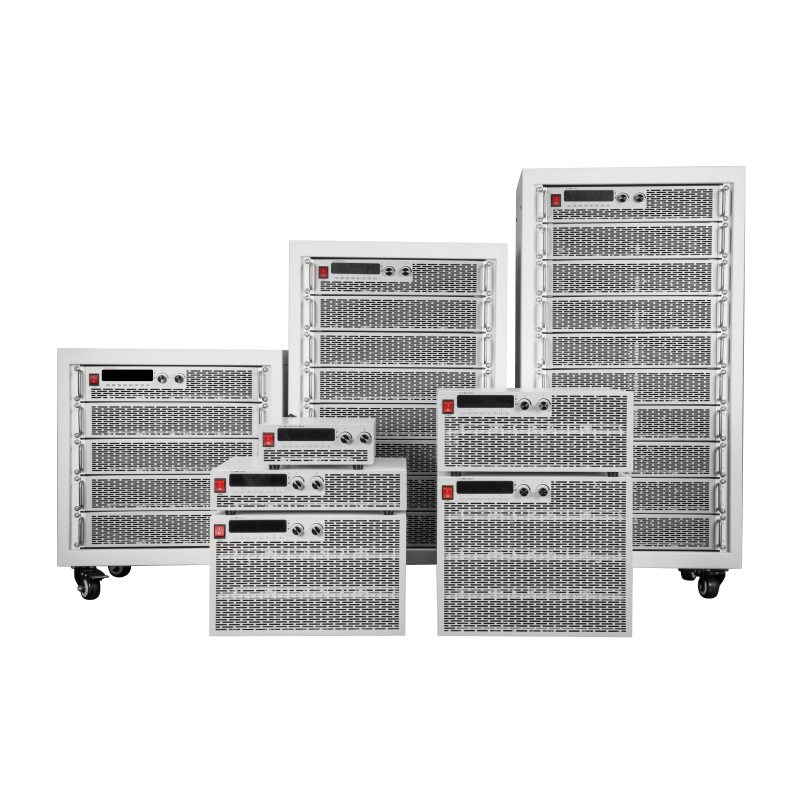
- Rack Mount: Test systems and data center applications
- Open Frame: Cost-optimized embedded solutions
Interface & Connectivity
- Connection Methods: Screw terminals, quick-connects, industrial terminal blocks
- Communication Protocols: Analog programming, RS-485/232, Ethernet, USB, GPIB
- Monitoring Capabilities: Real-time voltage/current readback, comprehensive status reporting
Compliance & Certification Requirements
- Safety Standards: UL/EN/IEC 62368-1, UL 508 (industrial applications)
- EMC Directives: FCC Part 15, CE marking, CISPR 11/32 compliance
- Industry Specific: Medical (60601-1), Automotive (ISO 16750), Aerospace standards
Practical Selection Methodology
Pre-Purchase Verification Checklist
- ✅ Voltage compatibility with project requirements
- ✅ Current capacity exceeding maximum anticipated demand
- ✅ Comprehensive protection circuitry (OVP, OCP, OTP)
- ✅ Appropriate efficiency rating for thermal management
- ✅ Valid safety certifications for target markets
- ✅ Correct physical configuration and mounting options
- ✅ Required communication interfaces and protocols
- ✅ Acceptable ripple and noise specifications
- ✅ Adequate line and load regulation performance
- ✅ Manufacturer warranty and technical support availability
Application-Specific Recommendations
- Prototyping & Development: Programmable bench supplies with monitoring capabilities
- Production Systems: Certified switching supplies with appropriate ratings
- Mission-Critical Applications: Linear supplies or premium-grade switching units
Conclusion: Engineering Excellence Through Proper Power Selection
Selecting the appropriate DC power supply may not be the most exciting aspect of project development, but it forms the foundation of system reliability and longevity. By methodically evaluating technical requirements, performance parameters, and application needs, engineers can ensure their creations operate as intended while avoiding catastrophic failures. The few minutes invested in proper power supply selection can prevent hours of debugging and protect valuable components from premature failure.